· 6 min read
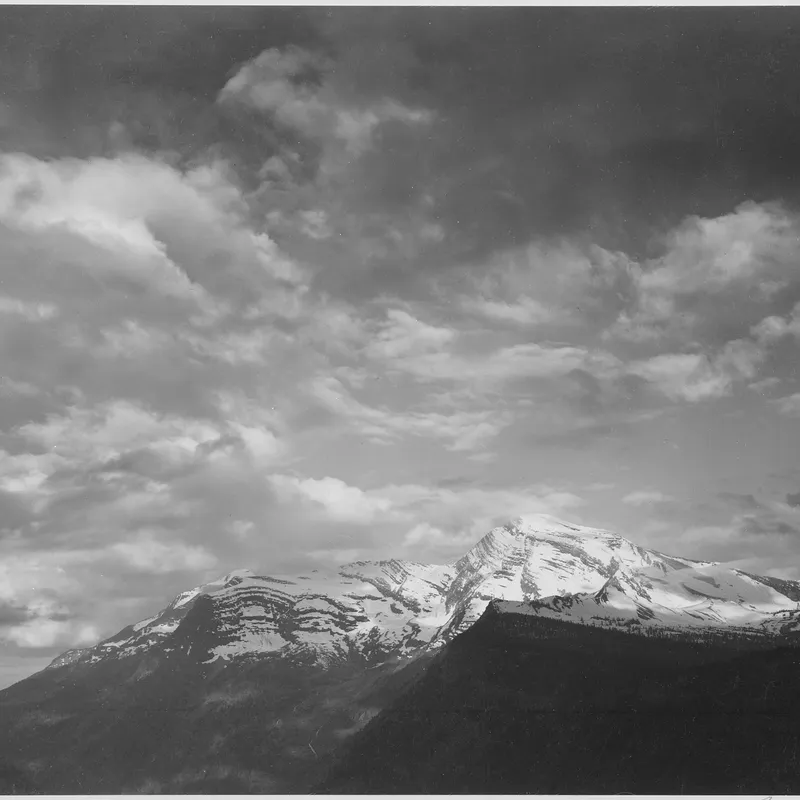
The Negative as Score: Adams, Print Values, and the Logic of Dodging and Burning
How Ansel Adams treated the negative as a fixed score and the print as performance, holding back and burning in to realize a visualized tonal scale.
Written in by Simon Lehmann Editor
The phrase “the decisive moment” is often reduced to a question of reflexes, as though the whole art lay in pressing the shutter a fraction of a second sooner or later than the next person. That reading misses half of what Henri Cartier-Bresson actually argued. For him, timing was inseparable from form: the instant worth catching was the instant at which the moving elements of a scene fell into a coherent geometric arrangement inside the rectangle of the frame. Understanding his method means treating composition and timing as a single act, then following that act through the camera, the film and the print.
The English label is partly an accident of translation. The French original, Images à la sauvette — roughly “images on the run” or “stolen images” — was published in 1952 by Tériade’s Éditions Verve in Paris, with a cover drawn by Henri Matisse. The American edition from Simon and Schuster carried the title that stuck: The Decisive Moment. The book opens with an epigraph from the seventeenth-century Cardinal de Retz: “There is nothing in this world that does not have a decisive moment.”
The preface is the one text the whole reputation rests on, so it is worth quoting exactly. “To me, photography is the simultaneous recognition, in a fraction of a second, of the significance of an event as well as of a precise organization of forms which give that event its proper expression.” And, more bluntly: “To photograph is to put on the same line of sight the head, the eye and the heart.” The decisive moment, on his own account, is the moment the geometry resolves.
Asked once what makes a good composition, Cartier-Bresson answered with a single word: “Geometry.” He distrusted formulae for it. “The only pair of compasses at the photographer’s disposal is his own pair of eyes,” he wrote in the same preface, and he hoped the day would never come when shops sold little schema grids to clamp onto a viewfinder — “the Golden Rule will never be found etched on ground glass.” The discipline lived in the eye, exercised until it became reflex; his dictum that “your first 10,000 photographs are your worst” frames timing as trained skill rather than luck.
Behind the Gare Saint-Lazare (Paris, 1932) is the textbook case. A man leaps across flooded ground, heel about to break the water, and the frame holds together because every element answers another: the leaping figure is echoed by a dancer on a poster behind him, the ladder lying in the water repeats the line of the railing, and the man’s reflection completes the curve his body has begun. A frame earlier and the foot is still aloft with nowhere to land; a frame later and the splash has broken the mirror. The geometry exists for one position only, and the timing exists to catch that position.
That insistence on a fixed pattern explains his refusal to crop. Cartier-Bresson composed within the viewfinder and treated the boundaries of the 24×36mm frame as settled at the instant of exposure rather than something to be renegotiated later. Every edge, the relation of figures to background lines, a diagonal balanced against a vertical — all of it had to be right before release, because nothing would be added or removed afterwards.
The claim is not just philosophy; it is physically checkable. A genuinely uncropped print carries a thin black border around the image, made by printing through the clear, unexposed film rebate at the edge of the negative. The rebate received no light, so it stays transparent on the negative and prints solid black. Darkroom workers achieved it by printing through a slightly oversized or filed-out negative carrier so that first millimetre of rebate showed. The black edge certifies that the printer worked the whole negative and nothing was trimmed.
The control was over the frame, not the chemistry. Cartier-Bresson developed and printed his own work only until about the end of 1935, then largely stopped. From its founding in 1950 his friend Pierre Gassmann’s Paris lab, Pictorial Service — known as Picto — produced virtually all of his prints; the same lab printed Capa, Chim, Doisneau, Ronis and Klein. The discipline divides cleanly: he owned the decisive instant in the viewfinder and delegated execution in the darkroom, with the full-frame rule as the one non-negotiable handed to the printer.
The 35mm rangefinder made this possible. From around 1932 Cartier-Bresson worked with a screw-mount (LTM) Leica fitted with the collapsible 50mm Elmar f/3.5, Leica’s standard general-purpose lens after its 1930 introduction; he later used a 50mm Summicron as well. The 50mm stayed his focal length for personal work because it sits close to the “normal” angle of view for the format. The 24×36mm frame has a diagonal of about 43.3mm, and a 50mm lens gives a diagonal angle of view of roughly 46° — neither the stretched perspective of a wide-angle nor the compression of a long lens, which suited a method built on the literal geometry of a space rather than on optical distortion.
Discretion mattered as much as optics. A small rangefinder is quiet and quick, and the chrome of the body was covered in black tape so it drew less attention on the street. The aim was to observe without being observed, leaving the scene undisturbed long enough for its forms to align.
Speed on the street came from not focusing at the instant of exposure. The technique is zone focusing — setting the lens in advance and letting depth of field cover the gap. A small aperture buys that depth, which is the practical sense of the old compression “f/8 and be there.”
A worked example with the 50mm makes the trade-off concrete. Taking a circle of confusion of 0.03mm, the hyperfocal distance at f/8 is about 10.5m: focus there and everything from roughly 5.2m to infinity is acceptably sharp. For closer street work, focusing instead at about 5m at f/8 gives a sharp band of roughly 3.4m to 9m. Set in advance, that band needs no adjustment, so the only variable left at the decisive instant is the shutter — and a fast shutter is what freezes the walking or leaping figure mid-stride. The aperture buys the zone; the shutter catches the moment.
The emulsion fit the method. From the mid-1950s Cartier-Bresson’s main film was Kodak Tri-X, rated ASA/ISO 400 — earlier he had worked on slower stock, so the high-speed habit belongs to the later career, not the 1932 images. Tri-X is a panchromatic film rated ISO 400/27°, and its appeal for unmetered street shooting is wide exposure latitude, commonly cited at five to seven stops. Light on a street changes faster than you can meter it; a film that tolerates being a stop or two off in either direction lets you keep the camera set and react to the geometry instead of the exposure.
A real development starting point keeps the timeline honest. Kodak’s datasheet F-4017 for Tri-X 400 (400TX) gives, in a small tank with 35mm film at 20°C, about 6¾ minutes in D-76 stock and about 9¾ minutes in D-76 1:1. The 1:1 dilution is the common working choice — a little finer grain and a longer, more forgiving time — and it is the natural partner to a 400-speed film carried through changing daylight. Fast film, modest aperture, pre-set focus: the whole chain is arranged so that nothing has to be decided at the instant the pattern closes except when to release.
The same instinct for control shaped how he held his work afterwards. In February 1947 the Museum of Modern Art in New York opened a major Cartier-Bresson retrospective, accompanied by the book The Photographs of Henri Cartier-Bresson. That same year he co-founded the Magnum Photos cooperative with Robert Capa, David “Chim” Seymour, George Rodger and William Vandivert, structured so that photographers retained copyright over their own pictures. Control of the frame at exposure, control of the full negative through to the print, and control of the rights to the image afterwards are the same discipline at three scales: the photographer decides what the picture is, and keeps deciding.
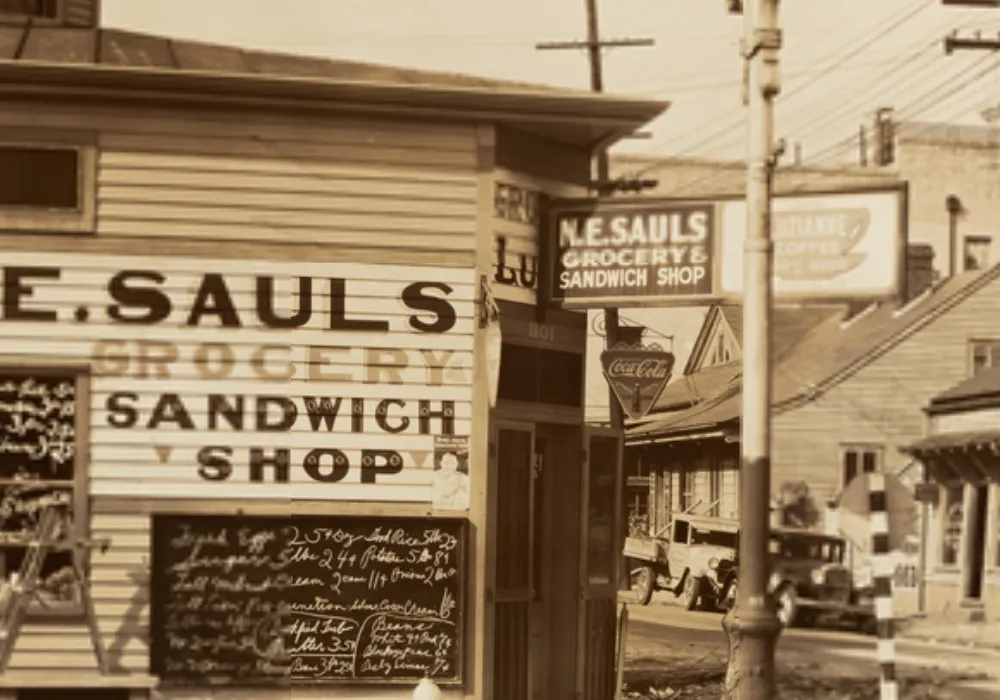
Image: Walker Evans / U.S. Farm Security Administration, Library of Congress (public domain)
· 6 min read
How Ansel Adams treated the negative as a fixed score and the print as performance, holding back and burning in to realize a visualized tonal scale.
· 8 min read
How shadow falloff on planar surfaces, hard graphic edges and the absence of colour make monochrome a natural language for architectural form.
· 6 min read
How Bill Brandt traded tonal fidelity for stark blacks, bleached whites, and the steep distortion of a wide-angle police camera.
The grainmag companion app
Meter and place your tones without a signal. No account, no internet required — just you, the light, and the grain.