· 6 min read
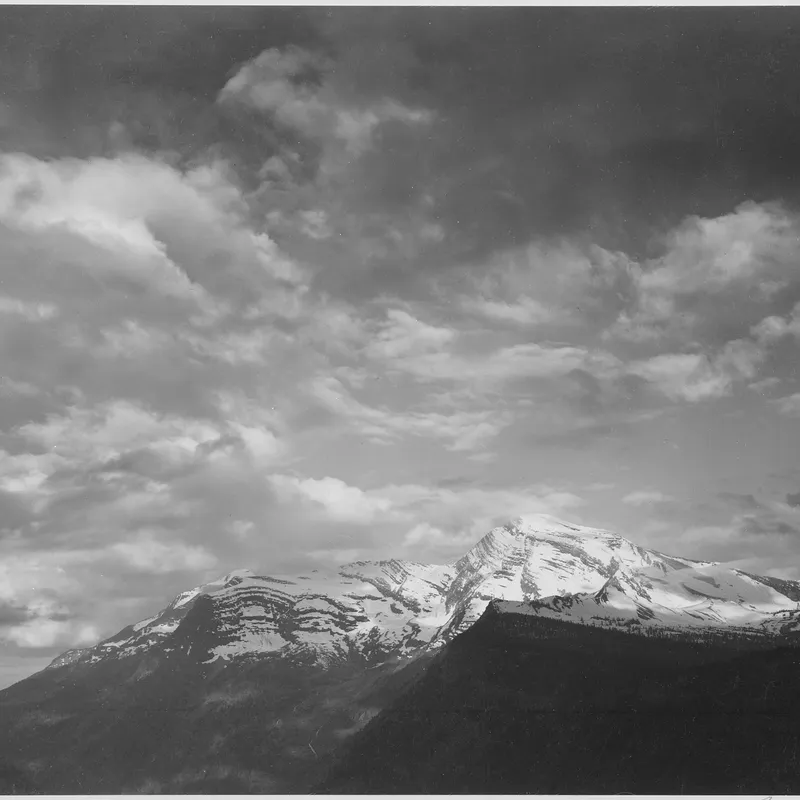
The Negative as Score: Adams, Print Values, and the Logic of Dodging and Burning
How Ansel Adams treated the negative as a fixed score and the print as performance, holding back and burning in to realize a visualized tonal scale.
Written in by Simon Lehmann Editor
A green bell pepper is an unpromising subject. It is glossy, irregular, and entirely ordinary. Edward Weston’s Pepper No. 30 reads less like a vegetable than like a torso or a clenched fist, and it was not luck. It was the end of roughly a week’s work. Weston had been photographing the same pepper for days; the negative he kept was the thirtieth, which is where the title’s number comes from. By the time he made it on 2 August 1930 the pepper itself had begun to fail, with a rotten spot visible on the lower right of the back of the pepper. The image came from a controlled chain of decisions about emulsion, light, aperture, development and printing, most of them settled before the shutter opened. It is a useful case study in how a black-and-white image is built on intention rather than discovery.
Weston is closely associated with previsualization: seeing the finished print, in full, before exposure. In his own words the goal was “the finished print pre-visioned complete in every detail of texture, movement, proportion, before exposure,” after which releasing the shutter “automatically and finally fixes my conception, allowing no after manipulation.” This is not the Zone System. The Zone System did not exist in 1930; Ansel Adams described it as “a codification of the principles of sensitometry, worked out by Fred Archer and myself at the Art Center School in Los Angeles, around 1939–40,” some nine years after the pepper. Weston’s practice was an intuitive, sensitometrically informed feel for how his materials behaved, not a formal placement of values on a numbered scale. The distinction matters: previsioning was a way of working, not a measuring system, and reading Adams’s grid back into 1930 misdescribes what Weston was actually doing.
Previsualisation in monochrome means knowing in advance how a colour will become a grey, and that translation is governed by the film’s spectral sensitivity. In 1930 a view photographer chose between orthochromatic emulsions, blind to red and weakly sensitive to green, and the newer panchromatic stocks that responded across the visible spectrum. A green pepper photographed on orthochromatic film renders as a fairly light grey; on panchromatic film the same green sits darker. Filtration shifts it again, a yellow or green filter lightening foliage values, a red filter driving green toward near-black. So the “green skin as a grey value” is not abstract: it is a concrete choice of Agfa or Ansco sheet film and any filter over the lens, made before exposure because it cannot be undone after. The tonal relationships Weston wanted were locked in at the moment he loaded the holder.
The sculptural quality of Pepper No. 30 is a lighting problem solved with a found object, but not with a hard raking lamp. Weston’s daybook records that he found the large tin funnel that same day and shot in fading daylight, soft and directional rather than the harsh artificial source the finished modelling might suggest. He called the funnel “a bright idea, a perfect relief for the pepper and adding reflecting light to important contours.” It did two things at once. As a dark, enclosing surround it isolated the pepper in relief, suppressing background tone. As a curved, specular metal surface it acted as a wraparound fill, bouncing the directional daylight back into the deepest folds so the shadows held detail instead of going dead black. Soft light grazing a rounded subject still produces modelling, because every ridge turns a gradient against the light, and the funnel’s reflection prevented that gradient from collapsing into murk. Form, not subject, became the content. Weston wrote that the pepper was “abstract, in that it is completely outside subject matter… this new pepper takes one beyond the world we know in the conscious mind.”
To hold the whole pepper sharp from front to back, Weston stopped down hard. The negative was made on an Ansco 8×10 Commercial View camera with a Zeiss 21 cm lens whose marked minimum was f/36; his grandson Kim Weston reports the working aperture was f/240, reachable only with a drilled drop-in Waterhouse stop, a flat metal plate with a single bored hole slid into the lens barrel in place of the iris. Such an aperture starves the film, which is why the exposure is reported as anything from about six minutes in Weston’s own daybook to four to six hours by Kim Weston; the fading-daylight working condition, with light dropping during a long exposure, makes the spread less of a contradiction than it looks.
It is tempting to say f/240 “buys sharpness.” Optically it does the opposite. Diffraction sets a hard limit through the Airy disk, whose diameter is roughly 2.44 × λ × N, where N is the f-number. For green light near 550 nm that is about 86 µm at f/64 and about 322 µm at f/240, nearly four times larger. At f/64 an 8×10 lens is already diffraction-limited to roughly 23 line-pairs per millimetre; at f/240 fine resolution falls about fourfold. What the tiny aperture actually buys is depth of field, paid for in resolution. The only reason that trade survives is that the image is never enlarged.
Weston tray-developed his Agfa and Ansco sheet film one sheet at a time, by inspection under a dark-green safelight, in ABC Pyro, a pyrogallol staining developer. ABC Pyro is a three-stock formula kept in separate bottles and combined only at use: stock A holds the pyrogallol with sodium bisulphite as preservative and a little potassium bromide as restrainer, stock B is sodium sulphite, and stock C is sodium carbonate, the alkali that drives development. The working bath is one part each of A, B and C to roughly seven parts water. The pyro stains the negative in proportion to density, adding edge acutance and restraining grain, which is exactly what a contact printer wants. Inspecting by eye let Weston pull each sheet when its tonal scale looked right rather than trusting a clock.
He then contact-printed on Kodak Azo, a slow silver-chloride paper, developed in Amidol for cold, deep blacks and a long tonal scale. Azo is the point, not a generic “silver gelatin” paper: chloride emulsion is far too slow to enlarge and can only be printed in contact, but it rewards that limit with a tonal range that bromide enlarging paper struggles to match. Kodak discontinued Azo around 2005; Michael A. Smith and Paula Chamlee created a replacement, Lodima, Amidol spelled backwards, so the chain can still be attempted today.
Pepper No. 30 exists as a silver gelatin contact print measuring 9½ × 7 9⁄16 in. (24.1 × 19.3 cm), the exact size of the 8×10 negative pressed against the paper. Because the print is the negative’s true size, nothing is magnified, including the diffraction loss from f/240, which is precisely why so extreme an aperture is tolerable here. There is no cropping and no enlargement to rescue a weak frame; the full negative had to be right in the camera. That constraint is the practical engine behind the previsioning, and it pre-figures the credo Weston would help write two years later when he co-founded Group f/64 on 15 November 1932 with Adams, Imogen Cunningham and his son Brett, a group named for the small aperture that gives maximum depth and resolution and committed to sharp, full-scale straight photography against soft-focus Pictorialism. When buying a print, it is worth knowing whose hands made it: Edward’s lifetime prints are distinct from the posthumous prints his son Cole Weston produced from the negatives and labelled as such. All of it is documented in The Daybooks of Edward Weston, Vol. II: California, edited by Nancy Newhall, where the funnel, the rot and the “more than a pepper” come straight from the entries of early August 1930.
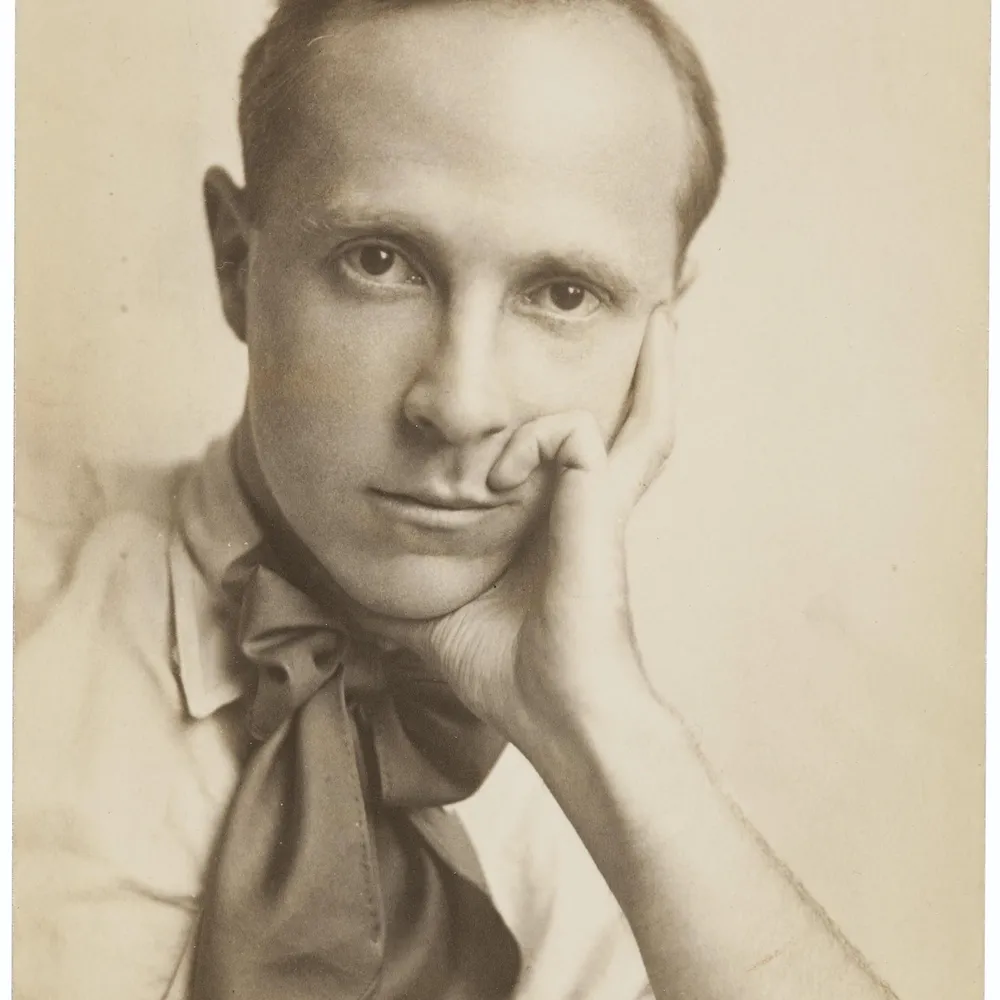
Image: Rae Davis, portrait of Edward Weston (c. 1914), via Wikimedia Commons, public domain
· 6 min read
How Ansel Adams treated the negative as a fixed score and the print as performance, holding back and burning in to realize a visualized tonal scale.
· 6 min read
How Bill Brandt traded tonal fidelity for stark blacks, bleached whites, and the steep distortion of a wide-angle police camera.

· 8 min read
How Cartier-Bresson fused timing with internal geometry, composing the full 35mm frame in the viewfinder and printing uncropped, with the Leica as a discreet tool.
The grainmag companion app
Meter and place your tones without a signal. No account, no internet required — just you, the light, and the grain.