· 5 min read
Acros II Reciprocity: Why Metered Exposure Holds Into Multi-Second Territory
How Fujifilm Neopan 100 Acros II resists reciprocity failure to 120 seconds, and what its Super Fine-Sigma grain delivers.
Written in by Simon Lehmann Editor
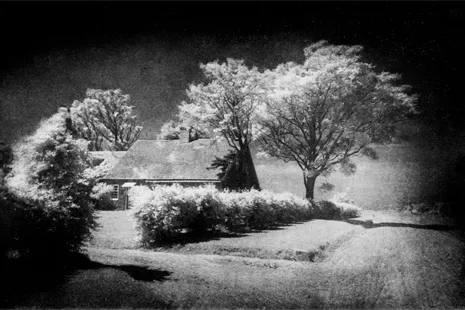
A landscape that looks ordinary to the eye can be transformed by film that responds to wavelengths the eye cannot see. Foliage glows white, blue sky collapses to near-black, and skin and water take on an unfamiliar smoothness. This is the so-called Wood effect, and it depends on two things working together: an emulsion sensitised beyond the red end of the visible spectrum, and a filter that blocks the visible light the emulsion would otherwise record.
The effect is named for the American physicist Robert W. Wood (1868–1955), who published some of the first photographs made on near-infrared-sensitive plates. His article “A New Departure in Photography” appeared in The Century Magazine in 1910 and showed near-infrared exposures with their characteristic white foliage and dark sky. That white foliage gave the phenomenon its name.
The reason foliage records as white is structural, not chemical. Chlorophyll absorbs strongly in the visible red, so healthy green leaves reflect only a few per cent of red light and look dark in a conventional red-filtered black-and-white photograph. Just past the visible spectrum, around 700 nm, the pigments stop absorbing and the air-filled spongy mesophyll inside the leaf scatters near-infrared very efficiently at its cell-wall interfaces. Reflectance therefore jumps to roughly 40–60 per cent in the near-infrared. That abrupt step around 700 nm is the “red edge” remote sensing exploits in indices such as NDVI, and it is exactly what an infrared-sensitive emulsion records as a pale, almost luminous tone.
The dark sky comes from the same shift in wavelength. A clear blue sky is bright because of Rayleigh scattering, whose intensity scales as 1/wavelength⁴. By the near-infrared that figure has collapsed, so the sky scatters very little and records as a deep, near-black tone once the filter has removed the visible blue the film would otherwise capture.
The classic strong-effect film is gone. Kodak High Speed Infrared (HIE) was discontinued on 2 November 2007. It reached to roughly 900 nm — the longest reach of any common pictorial film, optimal around 750–840 nm — and produced the most pronounced Wood effect. With nothing left from Kodak, the choice now falls to a short list of currently-made films, ranked here by infrared reach and effect strength:
HIE’s signature halo — highlights bleeding into a soft glow around branches and bright edges — is often mistaken for an inherent property of infrared light. It is not. HIE lacked an anti-halation layer and was coated on a transparent base, so light passed through, reflected off the back, and re-exposed the emulsion: blooming and halation. Every currently-made infrared film listed above carries an anti-halation backing, so SFX 200, Rollei Infrared and the Adox/Rollei Aviphot stocks render infrared cleanly, without the halo. If you want that glow, no living film will give it to you; if you want a clean infrared rendering, modern film is the better tool.
A red 25 filter passes visible red and the near-infrared while blocking blue and most green. It darkens skies and lightens foliage but still records a great deal of visible light, so the effect is mild. To build the image purely from infrared reflectance you fit an opaque filter that appears black to the eye and passes only the near-infrared. The longer the cut-off, the more purely the image is made of infrared, and the stronger the rendering. Approximate 50-per-cent transmission points let you rank them:
The de-facto standard pictorial filter is the Hoya R72, which passes 720 nm and longer, transmitting about 95 per cent across 760–860 nm. Ilford names equivalents directly for SFX 200: the B+W 092, Heliopan RG695 and the Hoya R72, along with the dedicated ILFORD SFX filter and the Heliopan 715. Rollei’s recommended filter for Infrared 400 is the Heliopan RG715. The redder the filter, the more dramatic the effect — and the longer the exposure.
This is the single most practical pitfall of infrared work. A TTL meter reading taken through a deep red or opaque filter cannot be trusted, because the meter and the film respond to the available light differently — and the error can run in either direction (Ilford, for instance, warns that some cameras under-expose by up to 1½ stops behind a deep red filter). The reliable method is an incident reading with a handheld meter, a film-specific exposure index, and a bracket on either side.
Concrete starting points, where the literature gives them: Kodak’s HIE data sheet (Publication F-13) specified EI 50 with a Wratten 25 in daylight using a handheld meter — and, for a camera metering through the lens with the filter in place, gave EI 200 as a starting point, advising you take the reading before fitting the filter and then ignore the filtered reading. Behind the opaque Wratten 87 it dropped to EI 25. For currently-made film, Rollei Infrared behind an RG715 is commonly rated around EI 6–12, and SFX 200 behind an R72 is rated well below box speed.
Filter factors follow the same logic. A red 25 costs about 3 stops. An opaque R72 or Wratten 87 costs far more, and there is no fixed number — the compensation depends on how much infrared the scene actually contains, which is why a bracket, not a single calculated exposure, is the right approach. With very dark filters exposures become long enough that a tripod is effectively mandatory.
A lens does not bring infrared and visible light to focus on the same plane. Optical glass refracts longer wavelengths less, so near-infrared converges slightly farther behind the lens; you must rack the lens very slightly forward — focus a touch nearer — for the infrared image to be sharp. A common rule places the correction at about 1/400 of the focal length, or in millimetres:
shift = focal length × 0.0025
So a 50 mm lens needs about 0.125 mm of forward movement, and a 100 mm lens about 0.25 mm. Many older manual-focus lenses carry a small red infrared index mark on the distance scale for exactly this, though the mark is approximate and the true shift is lens-design dependent.
Because an opaque filter makes focusing through the lens impossible, the order of operations matters. Work on a tripod, and: meter and compose the frame first; focus normally and read the distance opposite the standard index; rotate the lens so that distance sits opposite the red infrared mark; then fit the black filter. Stopping down to about f/11–f/16 buries most of the residual shift in depth of field, which is one more reason the long exposures of infrared work tend to be made at small apertures.
Infrared film still develops in ordinary chemistry. Ilford’s ID-11, Perceptol and Microphen all run in the 20–24 °C range, with the standing rule of adding about 10 per cent to the time for each degree below 20 °C. Microphen, a speed-increasing developer, is the one Ilford specifically cites as useful with SFX 200: SFX 200 rated at EI 200 develops in Microphen stock in roughly 8 min 30 s at 20 °C. HIE, for comparison, ran in Kodak D-76 for 10 minutes at 20 °C.
One loading caveat applies to the true infrared films. Rollei instructs that Infrared be loaded and unloaded in subdued light — some sources say complete darkness — because the felt light-traps of a 35 mm cassette can fog an emulsion this sensitive at the edges. Treat it like the sensitive material it is, and the frames will come back clean.
Sources: Ilford SFX 200, ID-11, Perceptol and Microphen Technical Information; Kodak Publication F-13 (High Speed Infrared); Hoya R72 product data; Rollei/Maco Infrared data sheet; Adox HR-50 product data; R. W. Wood, “A New Departure in Photography,” The Century Magazine, 1910.
Image: Robert W. Wood, first published infrared photograph (his summer home, East Hampton), The Century Illustrated Monthly Magazine, February 1910, public domain
· 5 min read
How Fujifilm Neopan 100 Acros II resists reciprocity failure to 120 seconds, and what its Super Fine-Sigma grain delivers.
· 6 min read
How inversion, twirl, and rotary agitation move developer across the emulsion, the patterns they leave, and how each shapes evenness and contrast.

· 6 min read
Why the blue filter exaggerates atmospheric haze and softens distance in black-and-white, and how it recreates the rendering of early orthochromatic emulsions.
The grainmag companion app
Meter and place your tones without a signal. No account, no internet required — just you, the light, and the grain.