· 6 min read
Gold Toning: Cool Blue Image Colour and Archival Permanence
How gold chloride deposits metallic gold over silver to cool a print toward blue, improve permanence, and produce red-chalk tones after sepia.
Written in by Simon Lehmann Editor
Selenium toner is most often described as a single-colour, all-or-nothing treatment: a print goes in, the blacks deepen, and a purplish-brown cast settles across the image. Used at full working strength to completion, that is roughly what happens. But selenium does not act on every density at once, and a print left in a weak bath reveals a sequence rather than a switch. The toner reaches the heaviest silver deposits first and works upward through the tonal scale only as time passes. That ordering is what makes split toning possible, and controlling it is mostly a matter of dilution, temperature and watching the print.
Selenium toning is a single-solution conversion reaction. The active ingredient, sodium selenite (Na2SeO3), supplies a selenide that combines with the metallic image silver to form silver selenide (Ag2Se), a far more stable compound that resists the atmospheric oxidation responsible for fading and discolouration in untoned prints. This conversion is the basis of selenium’s documented archival benefit, and it explains a detail the colour change alone does not: because the silver is only partially converted to the denser selenide, selenium-toned prints generally show higher density, higher contrast and a higher maximum density than untoned ones. Ilford’s Toning B&W Prints fact sheet (December 2001) records exactly this increase.
The reaction is not uniform across the print, and the reason is physical rather than mysterious. The deepest shadows hold the greatest mass of metallic silver and the largest reactive surface area, so they offer the most sites for selenide to attack. Conversion therefore proceeds fastest where silver is densest: the blacks convert before the mid-tones, and the mid-tones before the highlights. In a concentrated bath the whole scale converts quickly enough that the staging is hard to observe. In a dilute bath the same staging unfolds slowly and visibly, the shadows warming while lighter values stay neutral, which is precisely what allows the process to be interrupted partway.
Dilution sets both the pace and the colour. Ilford’s technical information for Harman Selenium Toner (June 2010) gives 1+3 for normal toning and a much weaker 1+20 for image protection with minimal tone change, where toning completes in 2-4 minutes. The hue depends on where in that range you sit: the Toning B&W Prints fact sheet documents that on Multigrade Warmtone, lower dilutions of 1+3 to 1+5 produce a purplish brown, while higher dilutions of 1+10 to 1+20 give only a slight cooling of the image tone and a shift towards red. Kodak’s Rapid Selenium Toner data describes the same split of behaviour: 1:3 for maximum effect, 1:20 or 1:40 to lift shadow contrast and Dmax with little colour change.
For split toning, work in the upper part of that range, around 1+10 to 1+20. You are deliberately trading speed for a wider observation window: the slower the conversion climbs the tonal scale, the easier it is to arrest it while the shadows have warmed and the mid-tones still read neutral. There is no fixed figure to time against, because the endpoint is judged by eye and drifts with the bath (see below). Attention stays on the deepest values, where the shift appears first.
Paper choice decides whether any of this is visible at all. This is the single most useful paper-specific fact, and Ilford states it plainly: Multigrade IV (a neutral emulsion) shows very little colour change in selenium, whereas Multigrade Warmtone is very responsive and well suited to splitting. Warm-tone emulsions run from a cool chocolate-brown through purplish brown toward little discernible change on cold or neutral papers. Choose Multigrade FB Warmtone if you want the separation; reach for a neutral paper and the effect may never appear.
Set up three trays. The centre tray holds the selenium working solution at 1+15, used at 20C/68F (within plus or minus 1C). The two flanking trays hold plain water roughly 4C/39F warmer than the toner, which steadies the reaction as the print passes between them. Make a second identical print and leave it in clean water beside the toning tray as a neutral reference; against it, the warming of the shadows is far easier to read than in isolation.
Slide the print into the toner and watch the darkest values. As the deepest shadows take a faint purple-brown and the mid-tones hold neutral, lift the print into the second water tray and agitate for 30-40 seconds to stop the action. If the shadows want more, return the print to the toner and continue; the staged, reversible nature of the bath is what makes this controllable. When the separation is right, wash thoroughly: RC prints for a further 2 minutes, fibre prints for at least 30 minutes in fresh running water above 5C/41F, or follow the Ilford optimum permanence wash sequence. Washing is not optional here, but it is also where the toning truly stops.
Selenium climbs from the shadows; an indirect sepia toner works the opposite way, because its bleach lifts the lightest densities first. The two are complementary, and run in sequence they give a print with two distinct colours: cool, near-neutral blacks against warm highlights.
Because sulphide and thiourea toning reduces density and contrast, expose and develop the print with about +50 per cent extra to bank the density sepia will take back. Use a stop bath (uneven development shows up badly after toning) and avoid hardening fixers, which impede toning. Tone in selenium first to lock the shadows: the silver already converted to Ag2Se resists the ferricyanide-bromide bleach, which is the real mechanism behind shadows that “hold their colour” through the second stage. Then dilute that bleach well below normal strength, to roughly one-fifth, so you can watch it lift only the highlights and light greys; about a minute is usually enough. Redevelop in an alkaline thiourea solution, which is the odourless alternative to smelly sodium sulphide. The warmth is set by the pH of that redeveloper: more sodium hydroxide gives a colder tone, less gives a warmer one. Tim Rudman’s The Photographer’s Toning Book documents this bleach-control approach in detail.
Gold combines differently, and the two cases are worth keeping straight. A gold toner used alone drives the image toward blue-black, cooling the shadows; gold used after sepia produces an orange-red. A partially bleached sepia print can also be carried into a blue iron toner for a blue/green/sepia split. The choice is yours, but name the effect you actually want before committing the print to a bath.
A workflow judged by eye is only as repeatable as the bath it depends on, and selenium does not hold still. Its capacity at 1+3 is at least the equivalent of 25 sheets of 20.3 x 25.4cm (8x10in) per litre, and working solution keeps up to six months in full, tightly capped bottles, a month half-full, and only about seven days in an open tray. As the bath ages and is used, the rate of tonal change becomes progressively slower, so the same elapsed time that gave a clean split last week will undertone this week.
The practical answer is to record dilution, temperature and elapsed time for every print even though you stop by eye, treat those figures as a starting estimate rather than a recipe, and refresh the bath as soon as conversion noticeably slows. Keep the chemistry clean between stages too: toner or bleach carried from one bath into the next contaminates it and produces muddy, unpredictable colour. With clean processing, a named responsive paper and an eye kept on the advancing tone, dilute selenium gives a degree of colour separation that no single full-strength bath can reach.
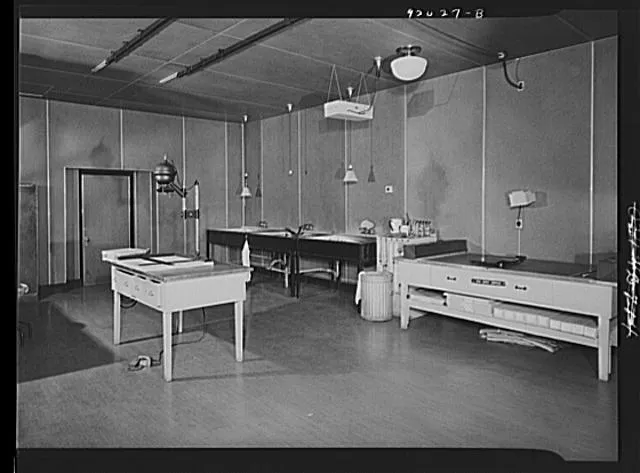
Image: Reginald Hotchkiss, FSA/OWI photograph laboratory enlarging room with developing sinks, Washington, D.C. (1941), U.S. Library of Congress, public domain
· 6 min read
How gold chloride deposits metallic gold over silver to cool a print toward blue, improve permanence, and produce red-chalk tones after sepia.
· 7 min read
How selenium converts image silver to stable silver selenide, what dilution and time control colour shift, and the effect on maximum black and Dmax.
· 6 min read
How the two-bath sulphide sepia process converts image silver to silver sulphide, and how bleach dilution controls warmth and split-toning.
The grainmag companion app
Meter and place your tones without a signal. No account, no internet required — just you, the light, and the grain.