· 6 min read
Center-weighted and matrix metering patterns
How camera meters average a scene with center-weighted and multi-zone matrix patterns, where each fails, and when an exposure override is warranted.
Written in by Simon Lehmann Editor
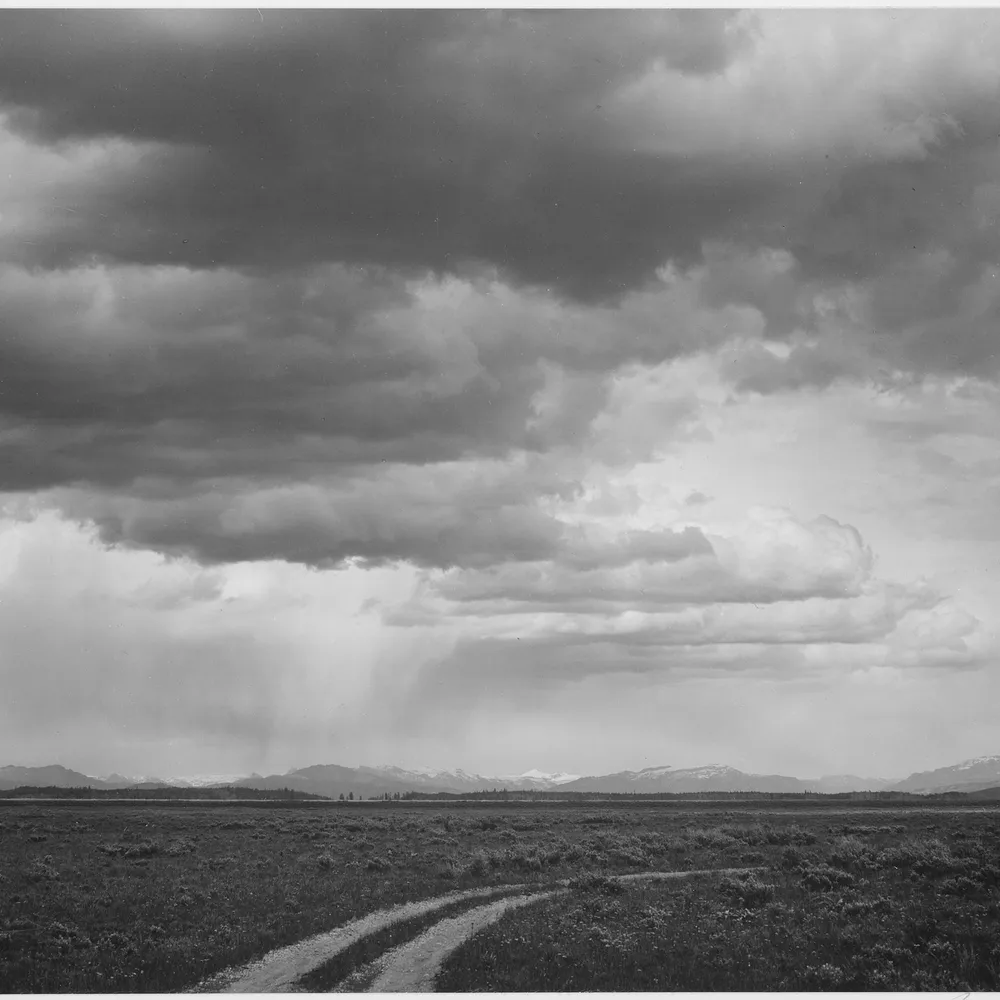
A landscape under a bright sky routinely spans a luminance range wider than a black-and-white negative can carry in one exposure. To know when that happens, you need a yardstick, and the Zone System provides it. Ansel Adams set it out in The Negative (1948, revised 1981): each zone is one stop, and the textural range — the tones that hold visible detail rather than blocking to black or blowing to white — runs from Zone II to Zone VIII, six stops. With Tri-X 400 or HP5 Plus at normal development you can stretch that a little further, holding roughly a seven-stop textured range and protecting highlights as the characteristic curve shoulders off gently. A clear midday sky, though, can meter four or more stops above shadowed land. Place the foreground where you want it and the sky climbs to Zone IX or X — white, no cloud detail. A graduated neutral density filter pulls that sky back down into the textured range at the moment of capture, darkening only the upper part of the frame so the whole scene fits.
A graduated ND filter is a rectangular sheet, dense at one end and clear at the other, with a transition zone between. Positioned so the dense half covers the sky, it holds back light there while passing the foreground unattenuated. Density is specified as optical density, D = log10(1/T): one stop is a halving of transmitted light, and log10(2) = 0.3010, so each stop of attenuation is 0.30 of density. A 0.9 grad therefore removes three stops, a reduction of 2³ = 8× in transmitted light. Manufacturers follow this scale directly — Lee Filters labels 0.3 as one stop, 0.6 as two, 0.9 as three — and the same 0.3-per-stop convention is industry-wide, shared by Formatt-Hitech, NiSi, Kase and Cokin.
The dye is meant to be neutral, but resin grads are not always perfectly so: shoot a frame entirely through the dense band and a faint cast can show up in the RGB readout, more often on cheaper resin than on Lee, which tests well for neutrality. Glass lines such as Lee’s Pro Glass, which grew out of Panavision’s cine requirements, were built to be effectively cast-free. For black-and-white work the colour itself is moot; what matters is that the dye stays neutral across the film’s panchromatic sensitivity, so it does not behave like a faint coloured filter lightening or darkening one part of the spectrum.
The filter you reach for is set by the gap between sky and land, not by guesswork. Spot-meter the sky filling the frame, then the foreground filling the frame, and read the difference in stops. One stop calls for a 0.3, two stops a 0.6, three stops a 0.9.
Take a coastal scene at dusk. The sky meters EV 13; a foreground rock meters EV 10 — a three-stop gap. Fit a 0.9 grad over the sky and the two halves come within range; then expose for the foreground, the clear-side reading, and let the grad bring the sky down to meet it. In Zone terms you are placing the rock on Zone V and dragging a sky that wanted Zone IX back to Zone VI, where cloud structure survives. Some photographers deliberately under-correct by a stop — a 0.6 across that three-stop gap — so the sky stays naturally brighter than the land rather than reading as an unnaturally even wash.
Filters differ not only in density but in how abruptly the dense region gives way to clear. Lee offers four edges on the same 0.3/0.6/0.9 densities: Soft, Medium, Hard and Very Hard. A Very Hard grad demarcates almost as a line, made for a flat sea horizon where bright sky and dark water meet sharply and the edge can be aligned precisely. A Soft grad feathers across a wide band, hiding the transition over a ragged tree line or a broken mountain skyline where a sharp edge would leave visible darkening on anything rising into it. Hard suits even horizons under longer lenses; Medium splits the difference. Lee markets Very Hard for seascapes and defined horizons, Soft for broken horizons and wide lenses.
How softly the edge records is governed by aperture and angle of view, not by depth of field at the subject. The filter sits centimetres from the front element, far outside any plane of focus, so its edge is always defocused regardless of where the lens is focused. Aperture sets how far that blur spreads: a wide aperture spreads it, a small one tightens it. Angle of view sets the rest, but in the opposite sense to what you might expect. A wide-angle lens takes in a larger slice of the filter, so the fixed physical transition band falls across a smaller fraction of the frame and even a soft edge reads as comparatively abrupt; a long lens sees only a narrow slice of the filter and magnifies the same band across the frame, so the transition is diffused and a soft grad can become almost invisible. This is why hard grads are recommended for telephoto and seascape work, where a soft transition would all but disappear, and soft grads for wide-angle, broken-horizon scenes, where a hard edge would read too suddenly — the choice cannot be made from the horizon alone.
A grad is the in-camera version of reduced development. Where it half-fixes a sky, contraction development finishes the job: develop FP4 Plus in ID-11 or D-76 at 1+1, pulling development by a couple of minutes from the normal time at 20°C, and a high-contrast scene contracts by a stop or two, the N-1 or N-2 of the Zone System. Filter and contraction combine — meter, grad the sky, then develop short to tame what remains.
The grad’s limits are geometric. Anything tall crossing the dense band is darkened with the sky: a lighthouse, a headland or a lone tree in a Hard grad’s path goes grey along its upper length, which is exactly why broken horizons take a Soft or Medium edge. On an ultra-wide lens a hard grad held in a 100mm holder can let the holder cut into the corners of the frame. When the skyline is too irregular for any edge, the alternative is bracketing and blending several frames. The trade is clean: a grad fixes the range in one exposure — indispensable for moving water, drifting cloud and film, where blending is impractical — but cannot follow a jagged outline; bracketing handles any skyline but needs multiple frames and a static scene. For the inverse problem, a low sun where the brightest band sits at the horizon rather than the top of the sky, reverse grads exist as a distinct class: densest along the centre line and lightening upward, the opposite of the standard grad’s top-heavy density.
Image: Ansel Adams, “Roadway, low horizon, mountains, clouded sky, Near (Grand) Teton National Park” (1933-1942). U.S. National Archives (NARA 519911), public domain.
· 6 min read
How camera meters average a scene with center-weighted and multi-zone matrix patterns, where each fails, and when an exposure override is warranted.

· 6 min read
How Bill Brandt traded tonal fidelity for stark blacks, bleached whites, and the steep distortion of a wide-angle police camera.
· 6 min read
Why the blue filter exaggerates atmospheric haze and softens distance in black-and-white, and how it recreates the rendering of early orthochromatic emulsions.
The grainmag companion app
Meter and place your tones without a signal. No account, no internet required — just you, the light, and the grain.