
· 6 min read
Bill Brandt: High-Contrast Printing and the Wide-Angle Nude
How Bill Brandt traded tonal fidelity for stark blacks, bleached whites, and the steep distortion of a wide-angle police camera.
Written in by Simon Lehmann Editor
Panchromatic film is called panchromatic because it answers to the whole visible spectrum, but the response is far from level. The emulsion has a genuine dip in the blue-green to green band, roughly 490 to 540 nm, and a pronounced rise at the red end, with sensitivity reaching out to around 660 to 730 nm depending on the stock. The eye sees a sunlit canopy as bright and full of variation; the film, sitting in its green trough while the reds run hot, collapses that canopy into a heavy, undifferentiated grey. The structure a woodland scene depends on disappears before any filter is added.
The exact red cut-off is film-specific, so the stock matters as much as the glass. Ilford’s curves put HP5 Plus falling off in the red at about 650 nm, while FP4 Plus carries its sensitivity nearly to 700 nm. FP4 Plus therefore records far-red foliage reflectance and warm subjects such as red brick or skin more strongly than HP5 Plus, and needs a touch more correction to bring foliage back. (35mmc, “Spectral Sensitivity of B&W Film,” 2 May 2023; Ilford FP4 Plus and HP5 Plus technical datasheets, HARMAN technology.)
A colour filter passes light of its own colour and absorbs its complement. A green filter transmits the green band and absorbs red, and to a lesser degree blue. Subjects that reflect green reach the film with more exposure and print lighter; those reflecting red are held back and print darker. That is why green lightens grass and leaves while darkening a red barn, red brick, or sunlit skin, all of which carry a strong red component. Green also has a property yellow and orange lack: it can darken sky and lighten foliage at once, and on panchromatic film it tends to hold an approximately normal contrast index while doing so. This is the classic remedy where red architecture would otherwise merge tonally into the foliage around it. (Ansel Adams, “The Negative,” The Ansel Adams Gallery; Ilford, “Using colour filters for black and white photography.”)
“Green filter” covers two quite different tools, and the original advice to reach for a Wratten 58 in the woods is wrong. The everyday foliage green is gentle: a Tiffen or B+W green, or the yellow-greens Wratten 11 (the older X1) and Wratten 13 (X2). Ilford gives a typical green a factor of 2, about one stop, and uses it almost exclusively for foliage, where it “lightens green foliage” for a more natural, lighter feel. The yellow-green 11 carries a factor of about 4, around two stops, and 13 about two stops as well.
The strong greens are a separate class. The Wratten 58 is a green tricolour, made for colour separation, not woodland walks. Its passband runs roughly 490 to 580 nm with the density minimum near 520 nm, and it carries a heavy infrared leak, transmitting again above about 750 nm, where its diffuse density falls back toward zero in the 800 to 900 nm region. Its factor is in the region of 4 to 6, two to two and a half stops. The deep green Wratten 61 (N) is stronger still, factor about 12, some three and a half stops per Adams and the Kodak filter data. These render foliage very light and are overkill for gentle woodland separation. (Kodak Wratten 2 #58 diffuse-density spectral curve, Eastman Kodak; Wikipedia, “Wratten number”; unblinkingeye.com, “B&W Filter Factors.”)
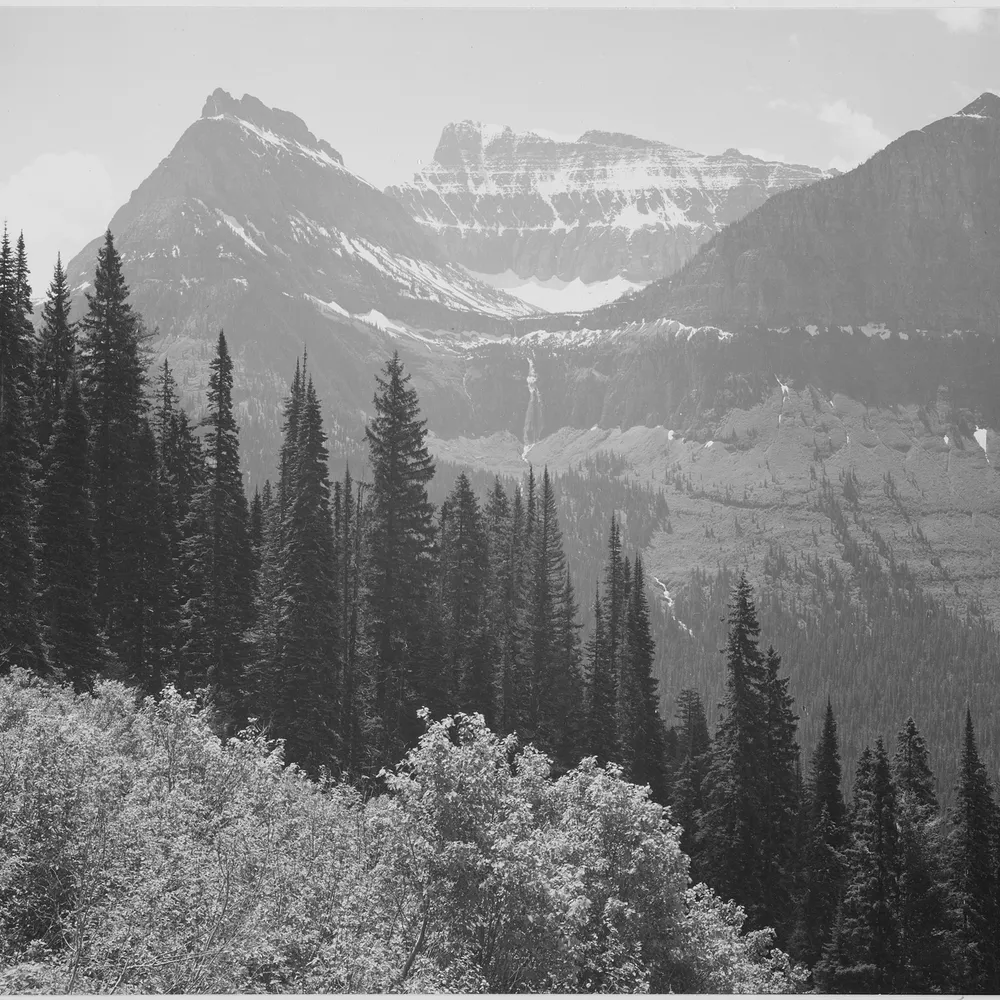
Living leaves do not behave as one tone under green, and this is the most useful woodland-specific caveat. Foliage reflects strongly in the near-infrared and often carries significant red, and sometimes yellow or even blue, reflectance. Broad-leaf deciduous canopy usually lightens under a green filter, because its visible reflectance sits where the filter is open. Conifers and junipers and other piney growth frequently do not lighten the same way. In a mixed stand the two diverge rather than flatten together, and that divergence is exactly the separation you are after. It also means the Wratten 58’s infrared leak is not academic: foliage’s high near-IR reflectance passes straight through that leak above 750 nm, lightening leaves further and unpredictably. (David Kachel, “Advanced Zone System Filters,” davidkachel.com; consistent with Adams on foliage filtration.)
Take FP4 Plus in daylight, metered with a spot meter. Bright spring growth reads high and you place it on Zone VI. A mid-toned deciduous leaf falls on Zone IV to V; a conifer in shade lands on Zone III. Unfiltered, those readings sit close together, because the film’s green dip pulls the deciduous mid-tones down toward the conifer and the picture compresses.
Add the foliage green, factor 2, and open exposure one stop to compensate. The deciduous leaf, reflecting where the filter transmits, climbs roughly a zone relative to the conifer and the reds, so the mid-canopy that was sitting on IV moves up toward V and detaches from the Zone III conifer below it. A yellow filter barely shifts the leaf tones, because it lightens green only modestly; it earns its keep on the sky, not in the canopy. Green is the filter that turns “finer separation” into a measurable zone of headroom between leaf and needle.
The same red absorption that darkens a barn darkens skin. Caucasian skin carries strong red and orange reflectance, so a strong tricolour green renders it markedly dark and unnatural; this is why the 58 and 61 are wrong for any scene with figures. The yellow-green Wratten 11 exists precisely for this compromise: it still helps foliage but keeps flesh tones natural, heightening skin contrast in monochrome without dragging it toward grey. When people appear in a landscape, that is the green to fit.
Two cautions on exposure. First, the factor is real light lost, so a hand meter needs it added manually while through-the-lens metering applies it for you. Ilford’s daylight factors are a useful baseline: yellow 2, green 2, orange 4, red 4 to 5, with the strong greens running far higher. Second, those factors assume daylight near 5500K. A filter’s factor shifts under tungsten, because the warm illuminant changes how much of the green passband reaches the film, so a factor quoted for daylight should be reconsidered under warm light. (Ilford, “Using colour filters for black and white photography”; Wikipedia, “Filter factor.”)
Image: Ansel Adams, In Glacier National Park, Montana (1941-42), U.S. National Archives, public domain
· 6 min read
How Bill Brandt traded tonal fidelity for stark blacks, bleached whites, and the steep distortion of a wide-angle police camera.
· 6 min read
Why the blue filter exaggerates atmospheric haze and softens distance in black-and-white, and how it recreates the rendering of early orthochromatic emulsions.
· 6 min read
How weighting red, green and blue channels in conversion reproduces the effect of physical filters, and where sensor color response sets the limits.
The grainmag companion app
Meter and place your tones without a signal. No account, no internet required — just you, the light, and the grain.