· 7 min read
Archival Washing of Fibre Prints and Residual Hypo Testing
How fixer is removed from a fibre paper base, the role of a hypo clearing agent, water-economical wash sequences, and tests for residual silver and hypo.
Written in by Simon Lehmann Editor
A properly fixed and washed silver gelatin print is already reasonably stable, yet the filamentary metallic silver that forms its image stays chemically reactive. Oxidising agents in the air — peroxides outgassed from cardboard and adhesives, atmospheric ozone and sulphur dioxide — drive a slow redox cycle in which silver is oxidised to silver ions, migrates, and redeposits as the orange-brown specks and mirrored edge sheen that conservators call redox blemishes. Selenium toning slows this by converting the metallic silver to a far less reactive compound, and the same bath simultaneously alters image colour and deepens the blacks. Those outcomes pull against each other: the brief, dilute dip that leaves colour untouched also leaves most of the silver unconverted, and the heavier treatment that genuinely armours the image is inseparable from a visible warm shift.
Selenium toner is a direct toner. The working solution — a dilute selenium-sulphite chemistry; Kodak states its Rapid Selenium Toner is built on a sulphite salt at under 2 percent, with the working bath holding less than half a percent selenium sulphite — reacts straight onto the metallic silver and converts it to silver selenide, Ag₂Se, with no intermediate. This is what distinguishes it from sepia and other brown toners, which first bleach the silver back to a halide and then redevelop it as silver sulphide, and from gold toners such as Kodak GP-1, which plate the existing silver with a protective skin of metallic gold. Because selenium adds density rather than removing it, Kodak notes that selenium tends to intensify the image, whereas sepia and brown toners reduce print densities — prints destined for sepia are deliberately made a shade darker to compensate.
The order in which tones shift follows surface area, not bulk. Conversion proceeds fastest where the silver is most finely divided and so presents the most surface to the bath. In a normal print the deep shadows carry the largest mass of silver but in coarse, high-surface filaments that react quickly and visibly; the delicate, sparse silver of the highlights is slower to register a change. The practical upshot is that shadows take on warmth and depth long before the upper scale moves at all, and chasing full conversion of the highlights means pushing the bath well past the point where the shadows first turned.
Protection scales with conversion, and that is the crux of the matter. James M. Reilly, director of the Image Permanence Institute, summarised the institute’s work in Topics in Photographic Preservation (1993, Vol. 5): IPI proposed an ANSI/ISO standard for silver-image stabilising treatments built around two tests, a hydrogen peroxide fuming test developed jointly by IPI and Kodak, and a dichromate bleach test that measures how much of the silver has actually been converted to a stable substance — gold, silver sulphide or silver selenide. The draft standard set the minimum acceptable conversion at 65 percent, read as Status A density. A toner protects only to the degree it converts; partial conversion buys partial protection.
This turns the article’s central tension into a number. Ilford states that at 1+20, protection of the image is complete in 2 to 4 minutes — but “complete” there means the visible toning has finished, not that 65 percent of the silver across the whole scale has become selenide. A short dip at high dilution stabilises image tone and deepens shadows while doing little for the highlights. The 65 percent figure itself came from IPI’s microfilm work, where bleached films converted to roughly 65 percent silver sulphide still made acceptable prints — the standard treats gold, silver sulphide and silver selenide as equally stable end-points and asks only how much of the image has actually been converted. Genuine archival permanence with selenium demands a heavier dose, and a heavier dose means accepting the colour shift.
The numbers come together in a real print. Take an Ilford Multigrade FB Warmtone sheet, developed in Dektol 1:2 for about two minutes at 20 °C. Fix it in a non-hardening rapid fixer — Ilford Rapid Fixer, or Kodak Rapid Fixer Part A only — because a hardened emulsion is less receptive to the toner and tones unevenly. Clear in hypo clearing agent, then tone in Kodak Rapid Selenium Toner at 1+20, 20 °C ±1 °C, for about three minutes, watching the print against a dry untoned reference of the same image. Ilford’s holding-bath trick guards against temperature shock: keep the rinse water either side of the toner roughly 4 °C warmer than the toner itself, so the emulsion never sees a sudden drop. Arrest in a holding bath with 30 to 40 seconds of agitation, then wash — two minutes for RC, at least 30 minutes for fibre in running water above 5 °C, an hour at 18–20 °C by Kodak’s reckoning unless a wash aid is used.
A single-step variant collapses the workflow. Both Kodak’s Publication G-23 and Alan Ross — who prints the Ansel Adams Yosemite Special Edition on Ilford Multigrade FB, Dektol 1:4 for about three minutes, fixed in Ilford Rapid Fixer 1:7 for two minutes — mix the selenium directly into a working solution of hypo clearing agent at 1+20 or 1+40, eliminating the wash between fixing and toning; roughly three minutes gives protection, longer gives more tone change. Ross’s sequence also encodes the oldest fixation test in the craft: a properly fixed print takes the toner cleanly, while one carrying residual silver-thiosulphate complexes from exhausted fixer converts those complexes to coloured silver selenide and stains — worst in the borders and highlights, exactly where stray silver lingers. Adequate fixation is confirmed when the print does not stain in the toner — the same behaviour Ansel Adams exploited in The Print.
Selenium raises maximum density, and Kodak G-23 publishes the curve to prove it: Polymax Fine-Art Paper, developed in Dektol 1:2 at 20 °C for two minutes and toned in Rapid Selenium Toner at 1:40 for four minutes, shows a measurable lift in upper-scale contrast and D-max over the untoned curve. The effect is optical: the conversion to silver selenide changes how the image-forming material in the shadows scatters and absorbs light, so the same silver now reads as a deeper, more opaque black. The gain is not open-ended — with most papers, toning past the optimum decreases Dmax again, so the densest result sits at an intermediate time rather than at exhaustion.
How much colour comes with that depth is the paper’s decision. Tim Rudman’s step-wedge comparisons across Ilford papers, run at dilutions from 1:20 to 1:2, document the spread: warm-tone and chlorobromide emulsions such as Ilford Multigrade FB Warmtone, Foma Fomatone and Adox MCC swing strongly toward chocolate- and purple-brown, while neutral papers like Ilford Multigrade FB Classic mainly deepen the blacks with little discernible colour change, and true cold-tone papers show almost nothing. If a cool or neutral print needs protection with no warm shift at all, selenium is the wrong tool — Kodak’s Gold Protective Solution GP-1 (gold chloride with sodium thiocyanate, around ten minutes at 20 °C to a slight bluish-black) is the alternative, plating the silver in gold rather than converting it.
Selenium is a heavy-metal toner and demands respect. Ilford’s technical sheet flags it as toxic if swallowed and a possible skin sensitiser: work in a well-ventilated space, wear gloves and eye protection, and never tip spent toner down the drain — it goes to a hazardous-waste point. One litre of Harman toner at the 1+3 dilution will tone the equivalent of at least 25 sheets of 8×10 before exhaustion, so a working session needs less than instinct suggests. Keep RC toning under roughly eight to ten minutes; beyond that the solution starts to penetrate the print edges. And whichever workflow you choose, the post-tone wash is not optional — the bath leaves sulphite and selenium compounds in the paper base that must be cleared, or the permanence the process is meant to deliver is undone by what is left behind.
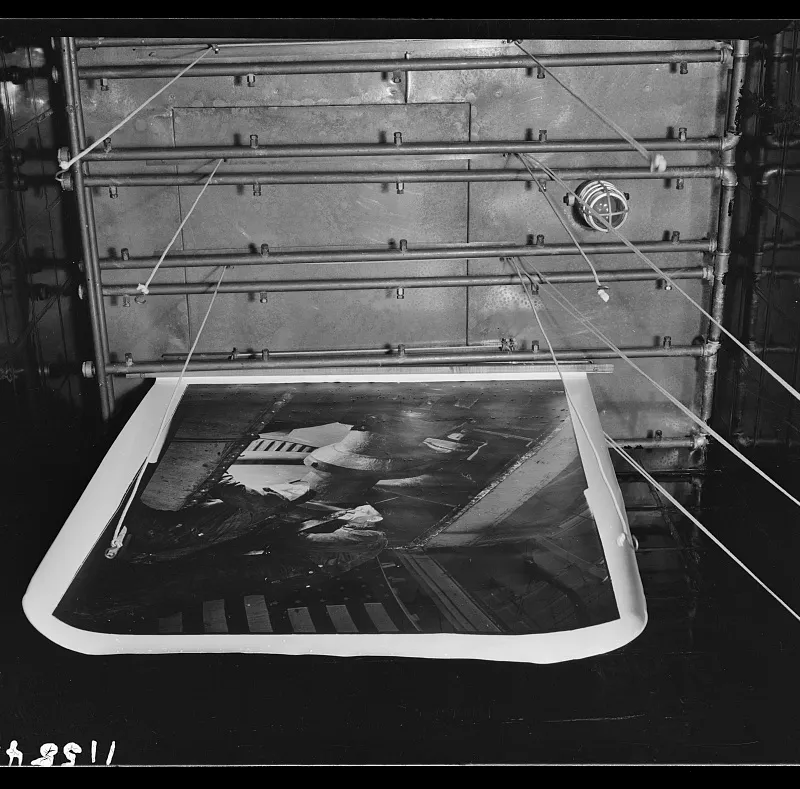
Image: U.S. Army Signal Corps / War Department photograph, “Enlarging, printing, and developing” (NARA 55163023). Public domain.
· 7 min read
How fixer is removed from a fibre paper base, the role of a hypo clearing agent, water-economical wash sequences, and tests for residual silver and hypo.
· 6 min read
Why thiosulfate fixer wears out, how retained silver complexes stain a negative, and the film-clip clearing test that flags a spent bath.
· 6 min read
How gold chloride deposits metallic gold over silver to cool a print toward blue, improve permanence, and produce red-chalk tones after sepia.
The grainmag companion app
Meter and place your tones without a signal. No account, no internet required — just you, the light, and the grain.