· 7 min read
Archival Washing of Fibre Prints and Residual Hypo Testing
How fixer is removed from a fibre paper base, the role of a hypo clearing agent, water-economical wash sequences, and tests for residual silver and hypo.
Written in by Simon Lehmann Editor
A finished silver gelatin print is, chemically, an image built from finely divided metallic silver. That silver is vulnerable: atmospheric peroxides, sulphur dioxide, and residual thiosulphate left from incomplete washing all attack it over decades, fading and discolouring the image. Gold toning is the least common of the traditional metal toners — Ansel Adams discusses it alongside selenium in The Print (Morgan & Morgan, 1950; revised New York Graphic Society edition, 1983) — yet it earns its place by doing two things at once that few other processes manage together: it shifts image colour toward a distinctly cool blue, and it lays down a noble-metal coating that is inert to the oxidising agents silver is not.
Gold toners are built around a dilute solution of gold chloride, almost always handled as a one percent stock: dissolve one gram of gold chloride in 100 ml of distilled water. Gold chloride is a bright yellow crystalline compound that is roughly 50 percent gold by mass, and it is by far the most expensive ingredient on the darkroom shelf — which is precisely why protective baths are kept dilute and toning times short.
The standard formula is Kodak’s long-published GP-1 Gold Protective Solution. To 750 ml of distilled water add 10 ml of the one percent gold chloride stock and 10 g of sodium thiocyanate (potassium thiocyanate may substitute in equal weight), then make up to 1000 ml with distilled water. That litre carries only 0.1 g of gold chloride — about 50 mg of actual gold — and tones roughly eight 8x10 inch prints before exhausting. The print must reach the gold bath fully fixed, fully washed, and free of residual fixer; thiosulphate dragged into the bath causes dichroic staining and wastes gold.
Take a sheet of Ilford Multigrade FB Warmtone, fixed and washed to archival standard, and slide it into GP-1 at around 20°C alongside a wet untoned offcut of the same paper as a reference. For the first half-minute very little appears to happen; thiocyanate is a mild silver solvent, so the image bleaches almost imperceptibly before it begins to intensify. Watch the deepest shadows against the offcut. The moment a just-perceptible shift toward blue-black is visible — typically before any obvious colour change reads in the highlights — lift the print. Held longer, the tone walks further toward cold blue and the apparent Dmax climbs as the gold builds. For protection alone you stop at “just noticeable”; for a deliberate cool rendering you carry on, accepting that a single litre will tire well before its eighth print if you push every sheet hard.
Gold does not simply replace silver. It deposits as colloidal, sub-micron particles over the existing image grains, and finely divided gold scatters short-wavelength light to appear blue or violet — the same physics that colours Purple of Cassius and cranberry glass. That scattering, not a pigment, is what cools the print. The smallest, most divided silver particles take the deposit first, so shadow structure and fine mid-grain respond ahead of broad highlights. With a thiocyanate toner the silver-solvent action explains the brief initial bleach noted above: the bath nibbles at the grain before gold plates onto it, and the deep purple-tending-black tone is the net result. Tim Rudman’s The Photographer’s Toning Book: The Definitive Guide (Argentum) treats this gold thiocyanate chemistry, and the bleach-back and gold-after-sepia variants, in detail.
The protection is mechanical and chemical at once. A coating of metallic gold — about as noble and unreactive a metal as exists — sits between the silver and the atmosphere, so the peroxides, sulphur dioxide and residual thiosulphate that would otherwise oxidise or sulphide the silver have far less of it exposed to attack.
For maximum archival benefit the thiourea variant GP-2 is documented as superior to GP-1. The formula: 750 ml distilled water, 0.5 g gold chloride, 1 g tartaric acid, 5 g thiourea, 15 g sodium sulphate, made to 1000 ml. Tested on Ilford Warmtone FB at 50 ml of bath per 6x2 inch print, two to three minutes confers considerable protection and longer is better. Gold-protected prints are reported more stable than those toned in selenium, and gold sits alongside sulphide as one of the strongest of the common protective treatments.
Gold also works as a split-toner over a prior selenium image, cooling it rather than warming it; selenium is itself a competing protective toner, so the two together both protect and shift colour. The order matters: tone, then wash thoroughly to a fixer-free state before the gold bath, so no thiosulphate enters the dilute, easily contaminated gold.
Gold behaves differently when it follows a sulphide image. Convert the print to silver sulphide by the two-bath sepia route — a thiosulphate/ferricyanide bleach followed by sodium sulphide redevelopment — wash it, then pass it through gold, and it does not turn blue. The cool gold deposit interacts with the warm brown sulphide to yield orange-red “red chalk” tones; the depth depends on how far the sepia conversion was driven and how long the print sits in the gold.
The canonical warm-tone-plus-gold process is the Nelson Gold Toner, essentially a hypo-alum (sulphide) toner with gold added. The gold acts catalytically, allowing the bath to run at 43°C (110°F) rather than the higher temperatures a plain hypo-alum toner needs. Toning can be stopped anywhere between roughly 5 and 20 minutes to control depth — from a hint of warmth to rich sepia-brown — and the final image is formed jointly from silver sulphide and gold, permanent on both counts. Replenish with about 4 ml of the gold solution after every fifty 8x10 prints when toning to a warm brown. As with the protective baths, gold’s final colour is governed as much by what lies beneath it as by the gold itself.
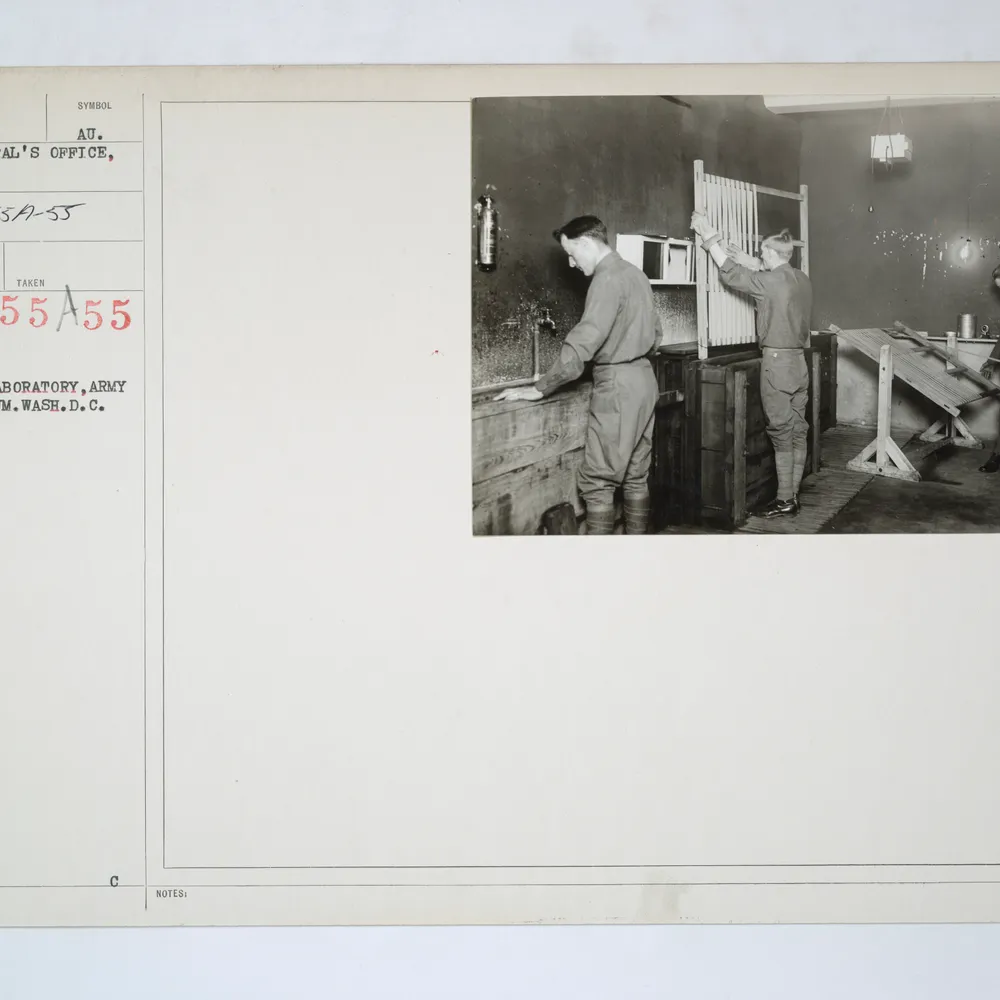
Image: Surgeon General’s Office, U.S. Army, Developing laboratory, Army Medical Museum, Washington, D.C., 1917-1918. U.S. National Archives (NARA 45496106), public domain.
· 7 min read
How fixer is removed from a fibre paper base, the role of a hypo clearing agent, water-economical wash sequences, and tests for residual silver and hypo.
· 6 min read
Why thiosulfate fixer wears out, how retained silver complexes stain a negative, and the film-clip clearing test that flags a spent bath.
· 7 min read
How weak selenium baths tone shadows before mid-tones, why the print must be watched to a chosen stopping point, and how to combine toners for two-colour results.
The grainmag companion app
Meter and place your tones without a signal. No account, no internet required — just you, the light, and the grain.