· 6 min read
The Negative as Score: Adams, Print Values, and the Logic of Dodging and Burning
How Ansel Adams treated the negative as a fixed score and the print as performance, holding back and burning in to realize a visualized tonal scale.
Written in by Simon Lehmann Editor
A straight print from a good negative rarely renders every region at the intended value at once. The exposure that holds detail in a bright sky will block up an open shadow; the time that opens that shadow will wash out the highlights. Dodging and burning resolve this by changing exposure locally rather than globally, so separate areas of one sheet receive different amounts of light. The operations are complementary: dodging withholds light from a region to lighten it, and burning adds light to darken it. Before any of that, follow the discipline Ansel Adams set out in The Print (1983, Book 3 of The New Ansel Adams Photography Series): make the first print straight, with no burning or dodging at all, so you can judge against it what the print actually needs.
The unit that matters is the photographic stop, not the raw second. Because a silver-gelatin emulsion responds to the logarithm of exposure, doubling the time anywhere on the sheet darkens that region by exactly one stop regardless of the base, and halving it lightens by a stop. Gene Nocon built a whole printing method on this in Photographic Printing (1987), dialling corrections in quarter-stop intervals on a matched timer; Ralph Lambrecht and Chris Woodhouse carried the approach forward in Way Beyond Monochrome.
The conversion you actually need at the easel is short. A +1 stop burn doubles the local exposure; +1/2 stop multiplies it by about 1.41; +1/4 stop by about 1.19. To turn a stop figure into seconds for a base of B seconds, a burn of n stops adds B × (2ⁿ − 1). On a 12-second base, +1 stop adds 12 seconds and +2 stops adds 36. Dodging runs the same arithmetic backwards: holding a tool over an area for d seconds of the base changes it by log₂((B − d)/B) stops. A 5-second dodge off a 20-second base is log₂(0.75) = −0.42 stop, just under half a stop lighter. The shortcut worth remembering is that the dodge time as a fraction of the base sets the stop change directly.
Take a 12-second base at grade 2.5 on Ilford Multigrade FB. The sky reads a stop too bright, so it needs +1 stop of burning: an extra 12 seconds, giving that region 24 seconds total. A foreground rock sits half a stop too dark and wants opening up. Dodging it for 3.5 of the 12 seconds gives log₂(8.5/12) = −0.50 stop; dodge a fuller 5 seconds and you reach log₂(7/12) ≈ −0.78 stop, which is closer to three-quarters and usually too much. So the map reads “sky +1 stop (burn +12s), rock dodge 3.5s.”
Process the finished sheet in Ilford Multigrade developer at 1+9, 20°C, for 2 minutes; the image should begin to surface around 35 seconds, and you can carry development to as long as 6 minutes with no real change in contrast. Stop in Ilfostop 1+19 for 10 seconds, fix in Ilford Rapid Fixer 1+4 for 1 minute (skip a hardening fixer, which only lengthens washing), then wash double-weight FB in running water above 5°C for 60 minutes, or cut that with Ilford Washaid.
Adjusting exposure alone cannot fix a region that is both wrong in tone and wrong in contrast, which is exactly the sky-versus-shadow problem. Split-grade printing solves it by separating the work onto two filters. Ilford’s published method exposes a variable-contrast Multigrade sheet twice: once through grade 0 (soft, controlling the highlights) and once through grade 5 (hard, controlling the depth of the blacks); the order does not matter.
Local control then attaches to whichever exposure does the right job. To deepen a blown sky without crushing the cloud detail, burn it during the grade 5 exposure only, so the added density lands as contrast in the shadows and midtones rather than flattening the highlights. To open a closed foreground shadow while keeping its separation, dodge it during that same hard exposure. The soft grade 0 pass, meanwhile, sets the high values across the whole frame. This is the dominant contemporary answer to a scene whose sky and faces will not sit on one grade.
Both operations live or die on continuous motion. A tool held still prints a hard-edged shadow as a visible halo or line. The reason is geometric: the tool casts an umbra, the region of full shadow, surrounded by a penumbra, the partial shadow. Because the enlarger’s lens or condenser acts as an extended light source rather than a point, raising the tool toward the lens and away from the paper widens the penumbra, softening the transition. Keeping the tool moving smears whatever residual hard edge remains so nothing prints as a line, and tearing the card rather than cutting it feathers the boundary further.
The tools themselves are simple. A dodging tool is opaque card or a torn shape taped to stiff wire, sized to the held-back area. Burning is the inverse, worked through an aperture: a hole torn in a large card, or the gap between two cupped hands, lets light reach only the chosen region while the rest stays covered. Adams pushed regional control to a physical extreme with a custom enlarger lit by a bank of 36 individually switchable lamps, but the same logic runs through a single torn card on a wire.
Judge burns against a dried print. On fibre paper, full blacks and full whites hold, but mid-tones and highlights gain density and lose a little local contrast as the sheet dries, so a wet sky that looks perfect is usually over-burnt once dry. Compensate by trimming overall exposure a small fraction of a stop; RH Designs meters offer a dedicated dry-down compensation setting for exactly this, adjustable in fine steps down to 1/12 stop. A near-universal finishing move is edge burning: burn the four edges roughly 1/4 to 1/2 stop, through a card aperture or with the easel blades kept moving, so the eye does not drift off the frame.
None of this is worth doing if you cannot repeat it. A printing map records the sequence: annotate the straight print, or trace the projected image onto plain paper and mark each area with its operation, such as “sky +1 stop” or “rock dodge 3.5s.” To convert that map back into exact action, use an f-stop timer such as the RH Designs StopClock, designed by Richard Ross, which lets you program a base plus dodge and burn steps in stop increments. Failing that, run test strips at the problem areas themselves, as Lambrecht and Woodhouse advise, rather than guessing the sky from a strip made across the foreground. This is the printer’s equivalent of the negative exposure and development notes the Zone System depends on; that system was codified by Ansel Adams and Fred Archer at the Art Center School in Los Angeles around 1939 to 1940, and Adams was careful to call it a codification of sensitometry, not an invention of his.
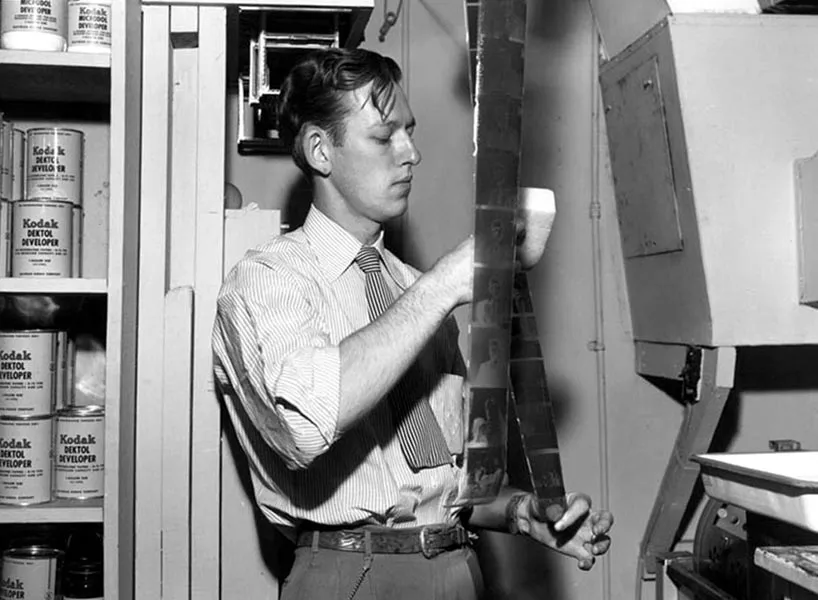
Image: Ed Westcott in his darkroom at the Clinton Engineer Works, Oak Ridge, 1945. U.S. Army Corps of Engineers / Department of Energy photograph (public domain), via Wikimedia Commons.
· 6 min read
How Ansel Adams treated the negative as a fixed score and the print as performance, holding back and burning in to realize a visualized tonal scale.
· 6 min read
How and when to bracket exposures by full and fractional stops, how to set the spread for film versus digital, and when brackets serve as insurance or as blending source frames.
· 9 min read
How fixed-grade and variable-contrast papers reshape a negative's tonal range, and how enlarger filtration sets contrast under the lens.
The grainmag companion app
Meter and place your tones without a signal. No account, no internet required — just you, the light, and the grain.